IPC Certification Soldering
Looking For A Top-Quality Soldering Course?
Make Sure You Contact Us!
At Marq One, we deliver soldering training aligned with the IPC J-STD-001 standard, an internationally recognised specification for soldered electrical and electronic assemblies. This training is designed for individuals working in production environments where soldering quality must be consistent, measurable, and compliant with defined industry requirements.
Rather than treating soldering as a standalone technical skill, our course places it within the context of controlled electronics manufacturing. The focus is on applying IPC requirements in a structured and repeatable way so that finished assemblies meet defined acceptance standards.
All training can be delivered either at our base in Nuneaton, on-site at your business, or remotely, meaning we can train your team in the way that works best for you.
IPC J-STD-001 As The Foundation For IPC Certification Soldering

IPC J-STD-001 defines the requirements for soldered electrical and electronic assemblies used throughout the electronics industry. It specifies the materials, processes and acceptance criteria needed to produce reliable soldered assemblies, helping manufacturers achieve consistent and internationally recognised quality standards.
The standard is used across a wide range of sectors, from general electronics manufacturing to high-reliability industries such as aerospace and defence. It categorises products into three classes according to their intended use and reliability requirements:
- Class 1: General electronic products
- Class 2: Dedicated service electronic products
- Class 3: High performance/harsh environment electronic products
Our training covers all three classes, with particular emphasis on Class 3 applications where product reliability and process control are critical.
The Soldering Course Structure And Content
Our courses integrate IPC requirements with practical manufacturing application. Participants are guided through key areas of printed circuit board (PCB) assembly, with each topic linked directly to industry-defined acceptance criteria.
Course content includes:
- Wire and terminal soldering
- Plated through-hole (PTH) assemblies
- Surface mount technology (SMT) processes
- Identification and prevention of component damage
- PCB coatings, encapsulation, and stacking considerations
- Inspection criteria for completed assemblies
Each topic is supported by clear reference to workmanship expectations under IPC standards. This enables learners to understand both the technical requirements and the assessment criteria used in production environments.
Practical Soldering Application
A key component of our training approach is the inclusion of practical soldering exercises. Participants complete assembly tasks on printed circuit boards under structured supervision, applying the methods covered in the theoretical elements of the course.
This practical application ensures that learners are able to demonstrate competence in producing assemblies that align with IPC requirements. It also reinforces the relationship between theoretical standards and real-world manufacturing activity.
During practical sessions, participants work with both through-hole and surface mount components. Instruction also covers the correct handling of soldering materials, including solder and flux, as well as preparation and inspection techniques used during assembly.
This course is intended for individuals with prior soldering experience. It is not designed as an introductory programme, but rather as a structured approach to aligning existing skills with IPC-defined requirements.
The IPC Certification Soldering Inspection Criteria
Inspection forms a significant part of IPC J-STD-001, and we incorporate this directly into its training delivery. Participants are trained to understand how soldered joints are evaluated and how acceptance criteria are applied in practice.
Our course introduces common defect types, explains how they occur, and outlines methods for preventing them through correct process control. This includes an understanding of how workmanship is assessed against defined IPC standards and why consistency is essential in maintaining product quality.
The objective is to develop the ability to identify compliant and non-compliant assemblies, as well as an understanding of how defects can be eliminated through controlled manufacturing processes.
Process Control And Manufacturing Consistency
A key objective of the training is to improve consistency in soldering processes across production environments. Variability in technique is a common cause of defects, which can lead to increased rework, scrap, and reduced manufacturing efficiency.
At Marq One, we address this through structured instruction in controlled processes, correct material usage, and repeatable soldering methods. Participants are shown how adherence to IPC standards reduces variation between operators and contributes to more consistent build quality.
Process control is also directly linked to inspection outcomes. A clear understanding of acceptance criteria enables operators and engineers to reduce errors and improve first-pass yield during quality checks.
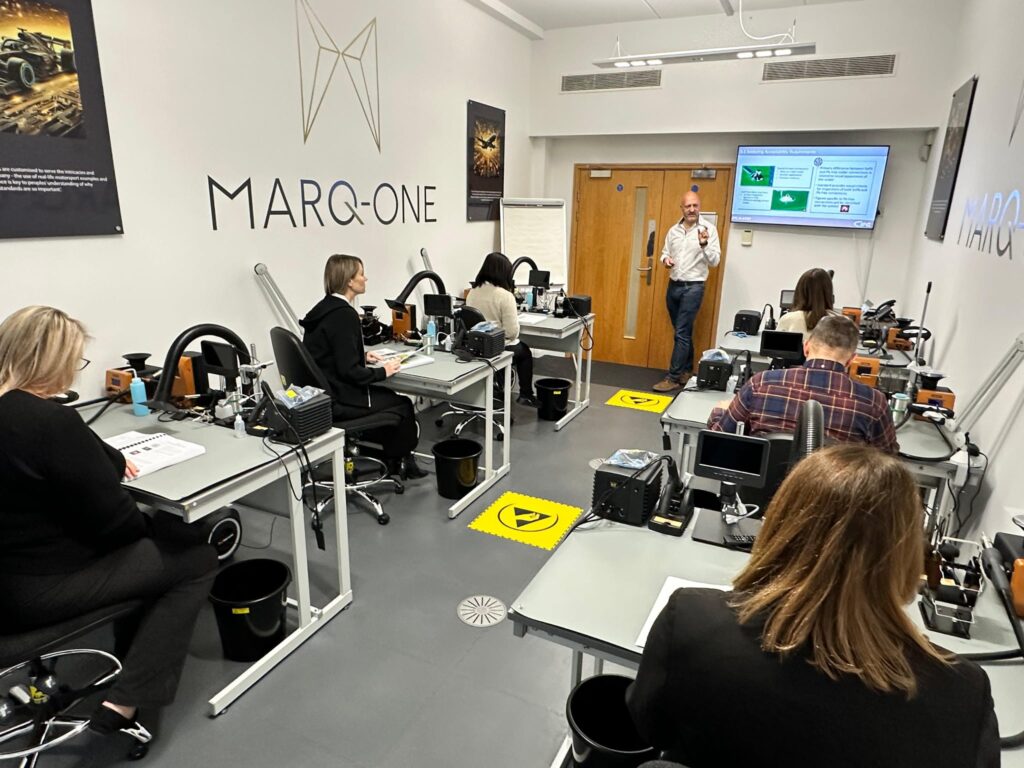
Who The Training Is Designed For
At Marq One, our soldering courses are intended for individuals involved in the manufacture, inspection, or oversight of electronic assemblies. This includes a range of operational and technical roles across electronics production environments.
Typical participants include:
- Assembly operators responsible for PCB soldering work
- Quality inspectors carrying out assembly verification
- Manufacturing and process engineers
- Quality assurance personnel
- Production managers and technical supervisors
This training is also relevant to senior personnel who require a working understanding of how soldering quality influences production performance, including factors such as rework rates, scrap levels, and customer returns.
While there are no formal entry requirements for the main IPC J-STD-001 course, participants are expected to have existing soldering experience and familiarity with industry terminology. The course is not intended to provide basic soldering instruction.
Space Addendum And High-Reliability Applications
In addition to the core IPC J-STD-001 standard, we provide training that includes the Space Addendum. This extension of the standard is designed for use in high-reliability environments where electronic assemblies are exposed to demanding operational conditions.
These conditions typically include vibration, thermal cycling, and other environmental stresses associated with space and defence applications. In such environments, solder joint reliability is a critical factor in overall system performance.
The Space Addendum introduces additional requirements that build on the base IPC standard, with a strong emphasis on process discipline, material selection, and enhanced inspection criteria. These elements are intended to support long-term reliability in mission-critical applications.
Entry to the Space Addendum course requires completion of IPC J-STD-001 within the previous three months. This ensures that all participants have a current understanding of the base standard before progressing to advanced requirements.
Industry Application And Training Value
IPC J-STD-001 training is widely adopted across electronics manufacturing because it provides a consistent and internationally recognised benchmark for soldering quality. Marq One’s training aligns directly with this standard, enabling organisations to implement a shared framework for production and inspection.
This alignment supports a reduction in rework and scrap by addressing inconsistencies in workmanship. It also strengthens audit readiness, as compliance with IPC standards is frequently used as a reference point for evaluating manufacturing capability.
In addition, the training promotes consistency across different functional roles within an organisation. By ensuring that operators, inspectors, and engineers work to the same standard, it reduces ambiguity and improves communication across production teams.
Why Choose Marq One For Your Soldering Course?
At Marq One, we deliver IPC J-STD-001 soldering courses that combine structured theoretical instruction with practical application in PCB assembly. The training covers key manufacturing processes, including through-hole and surface mount soldering, inspection requirements, and process control principles.
With coverage of all three IPC product classes and inclusion of the Space Addendum for high-reliability applications, the training is applicable across a broad range of electronics manufacturing environments, including aerospace and defence sectors.
The emphasis on standardised practice and applied learning ensures that participants can translate IPC requirements into consistent production output, thereby supporting improved quality control and reduced variability in soldered assemblies.